

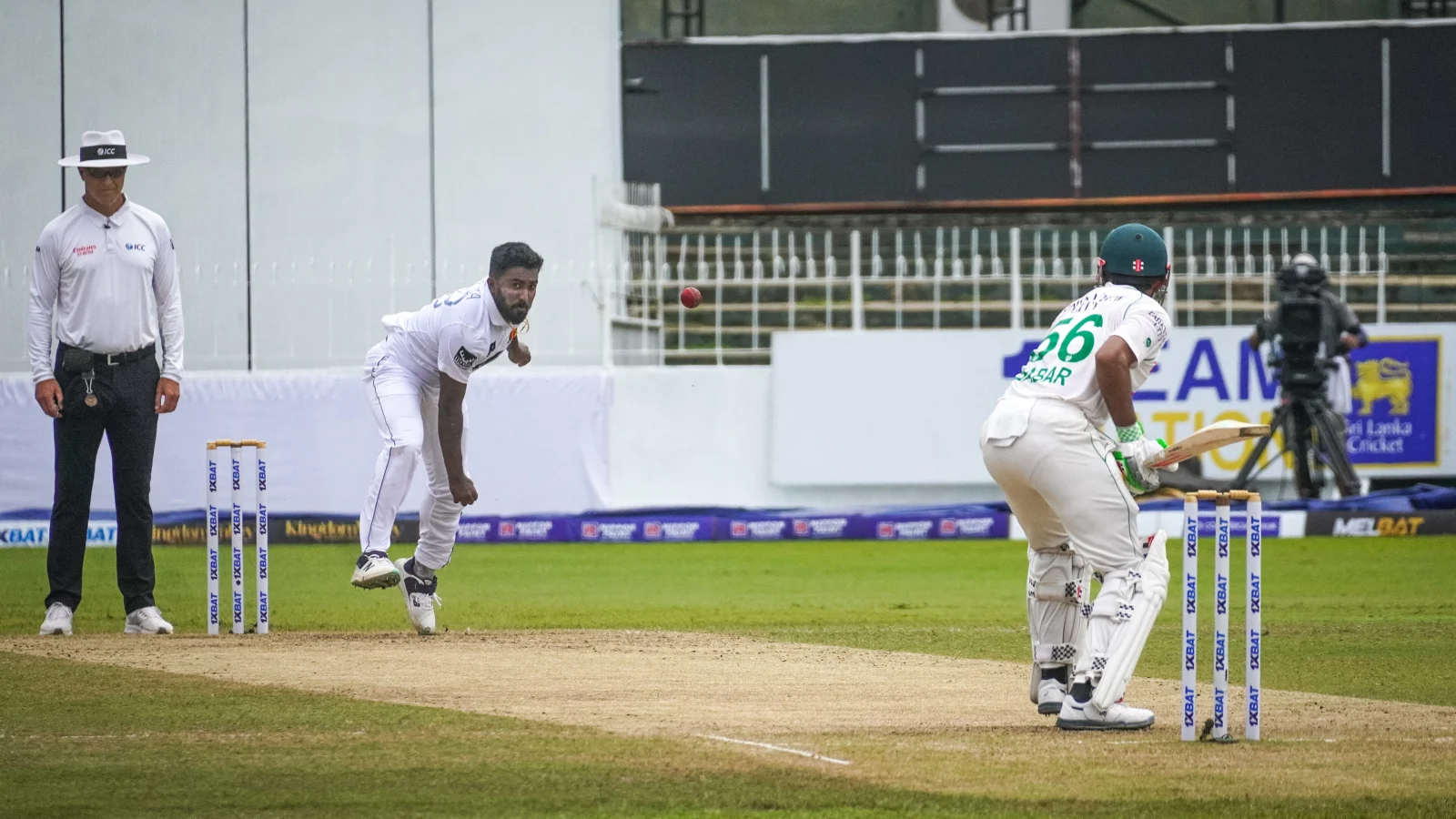
Pakistan’s newcomers have matched one of the rarest feats in Test cricket. Across the first two days of the first Test against Sri Lanka at the Rawalpindi Cricket Stadium, on 9 and 10 November 2026, debutants Tayyab Arif (57), Mohammad Taha (51) and Arafat Minhas (52) all made half-centuries in the same innings.
It is only the second recorded instance in Test history of three players reaching fifty on debut in one innings. The first came at Harare in October 1992, when Dave Houghton, Grant Flower and Andy Flower did it for Zimbabwe against India. Pakistan declared on 434 for 9, and Sri Lanka closed the second day on 114 for 3, still 320 behind.
The three debut fifties at Rawalpindi
| Debutant | Batting position | Runs | Balls | Fours | Sixes |
|---|---|---|---|---|---|
| Tayyab Arif | Opener | 57 | 51 | 9 | 1 |
| Mohammad Taha | No.3 | 51 | 105 | 6 | 0 |
| Arafat Minhas | No.8 | 52 | 72 | 9 | 1 |
The three innings could hardly have been more different. Tayyab, a 20-year-old right-handed opener, attacked the new ball from the start, reached fifty in 46 balls and shared an opening stand of 86 in 96 balls with Azan Awais. Pakistan passed 100 inside 21 overs.
Taha, a 26-year-old left-hander, did the opposite job at No.3. He reached fifty in 101 balls and batted 105 in all, adding 69 with Babar Azam and 68 with Saud Shakeel, before falling with the score on 227 for 4. Minhas then arrived at No.8 on the second morning, survived a skied chance dropped by Asitha Fernando at mid-on, reached fifty in 70 balls and added 85 runs across stands with Saud and Razaullah to take Pakistan past 400.
An aggressive opener, an anchor and a lower-order counter-punch: three debutants, three different roles, all ending past fifty in the same innings.
How Rawalpindi compares with Harare in 1992
| Zimbabwe debutant (1992) | Runs | Balls |
|---|---|---|
| Dave Houghton | 121 | 322 |
| Grant Flower | 82 | 297 |
| Andy Flower | 59 | 201 |
The Harare precedent came in Zimbabwe’s inaugural Test, when 10 of their XI were making Test debuts. The only exception was John Traicos, who had played Test cricket for South Africa in 1970. Zimbabwe made 456 in that first innings, with Houghton’s 121 the first Test century by a Zimbabwean.
That context makes the Rawalpindi version stand out. Zimbabwe fielded 10 debutants; Pakistan fielded four in an established side, and three of them passed fifty. The fourth, Saqib Khan, is a fast bowler. Even an inaugural Test does not guarantee the feat: when Bangladesh played their first Test, also against India, in November 2000, all 11 of their players were debutants, yet only two passed fifty: Aminul Islam with 145 and Habibul Bashar with 71.
Twelve new Test caps in a calendar year
The four debuts at Rawalpindi take Pakistan to 12 new Test caps in 2026, the most in any year since 1952. That year, as Pakistan played their first five Tests, all against India, 14 players received Pakistan caps. Two of them, Abdul Hafeez Kardar and Amir Elahi, had already played Test cricket for India.
The turnover shows in this XI. Seven of the 11 players at Rawalpindi made their Test debuts in 2026: Azan Awais, Ghazi Ghori and Razaullah earlier in the year, plus the four newcomers here. Only Babar, Saud, Salman Ali Agha and Mohammad Abbas pre-date this year.
The change follows a 3-0 series defeat in England in September, and Pakistan sit bottom of the World Test Championship table. Babar was open about the aim before the match: “We are pretty much out of the WTC this year, so we’re looking forward to the next one.”
There is a less flattering reading of the same numbers. This was Pakistan’s second squad reshuffle in two Tests. Two players were removed and four added less than 48 hours before Rawalpindi, after seven players were sent home and the head coach and bowling coach sacked before the Edgbaston Test. Babar has also said that selection is not in his hands. Turnover on this scale can reflect instability as much as a plan, and one strong innings does not settle which it is.
The caution is obvious. One innings is one innings. Tayyab came in on the back of 727 runs at 66.09 in seven matches for Kingsmen Academy in his first domestic first-class season; Taha was the third-highest run-scorer in the President’s Trophy Grade-I with 730 runs, including a highest score of 225. Those are strong domestic records, but Test careers are judged over far longer samples than a single first-innings fifty.
Tayyab Arif’s 46-ball fifty in context
| Batter | Balls to 50 on Test debut | Opponent | Venue | Year |
|---|---|---|---|---|
| Razaullah | 43 | England | Birmingham | 2026 |
| Tayyab Arif | 46 | Sri Lanka | Rawalpindi | 2026 |
| Faheem Ashraf | 52 | Ireland | Malahide | 2018 |
Tayyab’s half-century is the second-fastest by a Pakistan batter on Test debut. Two of the three fastest have now come in the space of two months, and both batters were in the same XI here.
The innings were built differently, though. Razaullah’s 43-ball fifty came from No.9 at Edgbaston, with Pakistan facing an innings defeat, and was powered by sixes. Tayyab’s came at the top of the order, against a fresh Sri Lanka new-ball attack, and relied mainly on fours: nine of them, plus a single six.
The experienced core still carried the innings
The debutants did not do it alone. Saud Shakeel top-scored with 93 off 199 balls before gloving a leg-side short ball from Fernando, which was the seamer’s 100th Test wicket. “You get too disappointed when you don’t complete a milestone,” Saud said afterwards. He shared a 96-run sixth-wicket stand with Ghazi Ghori, who made 48 off 72 balls. Babar scored 50 off 58, his second successive Test fifty after his 76 at Edgbaston.
| Pakistan batter | Runs | Balls |
|---|---|---|
| Saud Shakeel | 93 | 199 |
| Tayyab Arif | 57 | 51 |
| Arafat Minhas | 52 | 72 |
| Mohammad Taha | 51 | 105 |
| Babar Azam | 50 | 58 |
| Ghazi Ghori | 48 | 72 |
Six batters passed 45, yet nobody reached three figures. Sri Lanka’s seamers shared the wickets, with Asitha Fernando taking 3 for 107 and Dilshan Madushanka 3 for 108, while captain and wicketkeeper Kusal Mendis held five catches. Sri Lanka also conceded 27 extras, 15 of them byes.
Saqib Khan completes the debutants’ contribution
The fourth debutant made his mark with the ball. Saqib Khan, a right-arm seamer who took 47 first-class wickets at 20.60 in Karachi Blues’ title-winning Quaid-e-Azam Trophy campaign, struck with his ninth ball in Test cricket, edging out Dinesh Chandimal for 1, and later had Lahiru Udara caught behind for 42.
His 2 for 54 in 10.1 overs, alongside Mohammad Abbas’s early dismissal of Pasindu Sooriyabandara for a duck, left Sri Lanka on 65 for 3. Kamindu Mendis (40 not out) and Dhananjaya de Silva (22 not out) steadied the reply before bad light ended play early for the second day running.
What comes next
The first Test runs until 13 November. The second Test, from 17 to 21 November, will also be played in Rawalpindi after the Pakistan Cricket Board moved it from Lahore because of severe smog. All four debutants will therefore get a second Test on the same ground, which makes it a fair first check on whether Rawalpindi was a start or a peak.
The record is already secure. Whether this group becomes the core of Pakistan’s next Test side will be decided over the next two years of the World Test Championship, not over two days in Rawalpindi.

Join the conversation
0 comments