


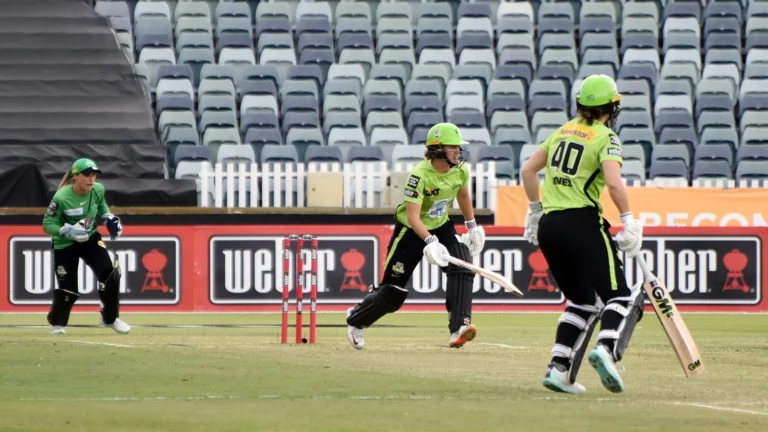
Sophie Devine retired herself out on 42 off 39 balls with three overs left of Perth Scorchers’ innings against Sydney Thunder at Drummoyne Oval on Thursday 5 November. Freya Kemp replaced her and hit 30 off 10 balls, Perth took 47 off the last 18 deliveries to reach 183 for 3, and they won by 17 runs.
Retiring out is not about to become a routine part of every T20 innings. But this decision shows when the tactic makes sense: plenty of wickets in hand, few balls left and a specialist hitter waiting. Perth had all three. When teams have used it without those conditions, it has often backfired.
What retired out means
Under the Laws of Cricket, a batter can retire at any time when the ball is dead. If they leave because of injury or illness, they are retired not out and can return later. If they leave for any other reason, they are retired out: it counts as a dismissal, no bowler is credited, and they cannot bat again unless the opposing captain agrees.
That is the trade. A team gives up one wicket to replace a batter who is not scoring quickly with one who might. The retired batter stays in the match and can still bowl and field.
The numbers behind the decision
Devine started well. She scored 32 off her first 23 balls, a strike rate of 139, while she and Beth Mooney built a partnership of 85 off 66 balls. Then she slowed down, managing 10 off her next 16 deliveries, a strike rate of 62.5.
At the end of the 17th over Perth were 136 for 2, a scoring rate of exactly eight an over. Devine walked off and Kemp, the 21-year-old England all-rounder, walked out. She hit three sixes and two fours before she was caught off Hannah Darlington in the 20th over.
Over the last three overs Perth scored at 15.7 an over. Kemp’s 30 off 10 was the bulk of it, with Mooney adding 14 off seven on her way to 80 not out, her 49th WBBL half-century, a competition record.
Mooney was clear about where the decision came from. “Sometimes when you’re batting, no matter how hard you try, it just doesn’t come off, and Soph recognised that,” she said. “It’s hard watching a six-hitter walk off the field, but Freya came out and absolutely whacked it.”
The decision also cost Perth very little beyond the wicket itself. Devine came back to bowl three overs, took 2 for 31, including Heather Knight stumped by Mooney. Alana King then took 4 for 35 as the Thunder, at one stage 144 for 5, lost their last five wickets for 22.
Why the timing mattered
Every retirement has the same cost: one wicket. The value of that wicket depends on how many you have left and how many balls remain.
Perth had lost only two wickets with 18 balls to go. Six of their players never batted. With so few balls left, the chance of Perth losing all their remaining wickets was very small, so the extra wicket was almost free. The real question was whether Kemp would score faster than Devine over those 18 balls. Given Devine’s previous 16 deliveries, Kemp did not need to do anything special to be an improvement. She came in with a T20I strike rate of 144 for England, and she had batted at No. 4 in Perth’s previous match too, so the move changed when she arrived rather than who arrived.
Even if Kemp had gone out first ball, Perth would have been three down with more than two overs left and a long batting order still to come. The tactic carried very little risk.
When retiring out goes wrong
The situations where retiring out has failed look quite different.
| Batter | Match | Score when retired | Situation | Outcome |
|---|---|---|---|---|
| Sophie Devine | Scorchers v Thunder, WBBL, Nov 2026 | 42 off 39 | 136 for 2, 18 balls left | 47 off the last 18; won by 17 runs |
| Harleen Deol | UP Warriorz v Delhi Capitals, WPL, Jan 2026 | 47 off 36 | 141 for 3, three overs left | 13 for 4 in the last three overs; lost by seven wickets |
| Mohammad Rizwan | Renegades v Thunder, BBL, Jan 2026 | 26 off 23 | About 154, end of 18th over | Replacement run out first ball; 16 more runs; lost by four wickets (DLS) |
| George Balderson | Lancashire v Somerset, T20 Blast semi-final, Sep 2025 | 7 off 6 | 19th over, chasing 183 | Replacement out first ball; all out for 159, lost by 23 runs |
| Nikolaas Davin | Namibia v England, T20 World Cup, 2024 | 18 off 16 | After six overs of a 10-over chase | England won by 41 runs |
The Deol case is the closest comparison. Like Devine, she had been set for a long time and was retired with three overs left. The difference was what came next. Her replacement, Chloe Tryon, lasted three balls, UP Warriorz added only 13 runs while losing four more wickets, and Delhi won comfortably. The next day Deol scored 64 not out off 39 balls and was named Player of the Match against Mumbai Indians.
The lesson is that a retirement only works if the new batter does better. A replacement who gets out quickly can make things worse, because another new batter then has to start from scratch with even fewer balls left.
Balderson’s case shows the same risk in a chase. Tom Hartley came in and was out first ball. In Rizwan’s case, captain Will Sutherland came in himself and was run out after facing one ball, and the Renegades added only 16 more runs. Much of the debate afterwards was about how the decision looked, with some arguing it should have come earlier and others asking whether a senior international should be removed that way at all.
Why it matters that it was Devine
In January 2026, after Gujarat Giants retired out Ayushi Soni in the Women’s Premier League, Devine was asked about the tactic. Her answer was clear.
“I think it’s just another tool and another strategic option to use,” she said. “For me, it’s for the benefit of the team and putting the team first and what the team requires.” She added: “I think it will be something that will become more and more common.”
Ten months later, she applied the same reasoning to her own innings. Devine is one of the most accomplished batters in the women’s game, a former Perth captain and the club’s second-highest run-scorer. Reports say she made the decision herself, and Mooney’s comments support that.
That matters for the stigma attached to the tactic. After India’s Women’s T20 World Cup exit in June, commentator Aakash Chopra argued: “My issue is that retiring out a batter is still seen as taboo, as if retiring a batter out means you’ve insulted them.” When a player of Devine’s standing chooses to walk off, it becomes harder to treat retiring out as a humiliation imposed on a struggling batter.
Communication is part of that too. Devine said in January that “communication is really important and understanding the reasoning behind why you would have retired someone out”. A retirement agreed in advance, or chosen by the batter, avoids the awkward scenes seen in other leagues.
So, is this the future?
It is becoming more common. Six batters were retired out in professional T20 cricket in the first 12 days of 2026 alone, across the BBL, SA20 and New Zealand’s Super Smash, and the WPL then had its first two cases on consecutive days that month.
But it is not a universal answer. On the evidence of these cases, it works under specific conditions:
- Wickets in hand. Two or three down, not five or six.
- Very few balls left. The last two or three overs, when the extra wicket is unlikely to matter.
- A clear slowdown. Devine’s 10 off 16 was a real drop, not a short quiet spell.
- A hitter next in line. Kemp was due in next anyway. The retirement simply brought her to the crease earlier, with time to use her power.
- Agreement from the batter. It goes more smoothly when the batter accepts the decision, as Devine did.
When these conditions are missing, a retirement is a gamble and can backfire. When they are all present, as they were for Perth on Thursday, it is simply a sensible use of the resources available. Retiring out should not be seen as an admission of failure. Sometimes it is just the right decision for the team.



Join the conversation
0 comments