

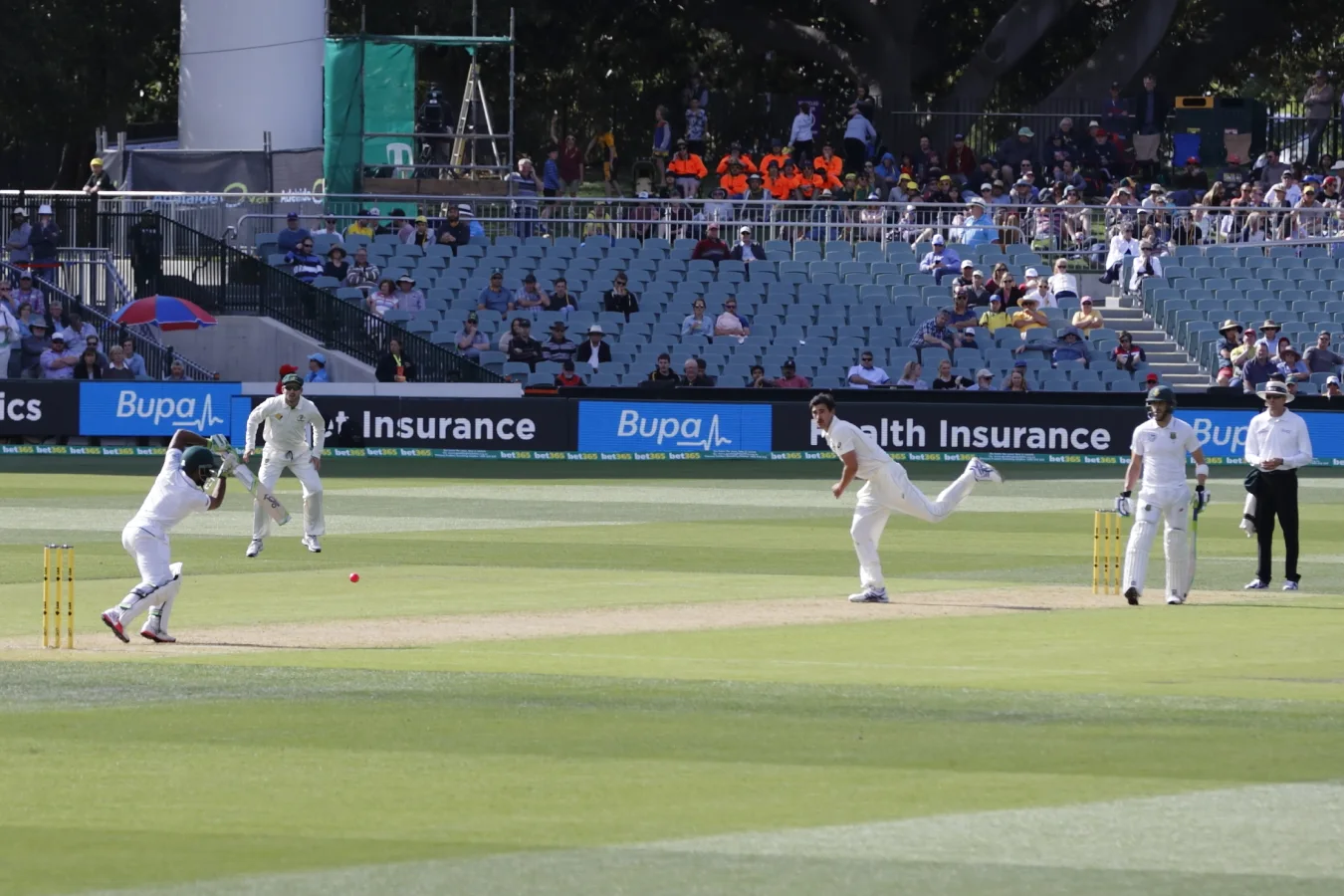
Brian Lara has called Temba Bavuma’s 179 against Australia in Gqeberha one of the great Test innings of this era. Writing on Instagram before the series decider in Cape Town, the former West Indies captain said: “Temba’s magnificent 179 was, in my view, one of the great Test innings of this era. To produce that kind of performance under pressure, when your team needs you most, speaks volumes about the man and the captain.”
Lara’s verdict rests on pressure and need, and the scorecard supports both. Bavuma walked in at 12 for 2, with South Africa already a Test down, and was out with his side on 425 for 9 and in control of a match they won by an innings and 31 runs. He was named Player of the Match.
The situation when Bavuma walked in
South Africa arrived in Gqeberha after losing the first Test in Durban by 214 runs, the first defeat of Bavuma’s Test captaincy. Australia won the toss and bowled first at St George’s Park. Rain meant only 43 overs were possible across the first two days, and only about an hour’s play on the first.
Bavuma came in during the ninth over, after Aiden Markram and David Bedingham fell with the score on 12. In his own words, everything was in the bowlers’ favour: the overhead conditions, the pitch and the early wickets. The innings kept losing partners around him, slipping to 40 for 4, 92 for 5 and 97 for 5 at the end of the second day. Early on the third morning Wiaan Mulder became Mitchell Starc’s 450th Test wicket, leaving South Africa 110 for 6.
At that point Bavuma had 43. The rest of South Africa’s top seven made 65 runs between them in the entire innings.
How he built it: three innings in one
The partnership data shows an innings that changed shape with the match situation.
| Phase | Score when it ended | Bavuma’s runs | Balls | Strike rate |
|---|---|---|---|---|
| Survival: with four partners | 110 for 6 | 43 | 127 | 33.9 |
| Rebuild: with Marco Jansen | 242 for 7 | 45 | 86 | 52.3 |
| Control: with Simon Harmer | 425 for 8 | 91 | 120 | 75.8 |
In the first phase, the task was to stay in. Bavuma scored at about a run every three balls while four partners came and went. He has described his method simply: stay as tight as possible and hit the ball as straight as possible. Bavuma, who stands 1.62m, has said he tries to play the ball as close to his body as he can rather than relying on a big stride.
The second phase began when Marco Jansen joined him. The pair added 132 for the seventh wicket from 185 balls, with Jansen making 85. It was South Africa’s highest seventh-wicket stand in a Test at St George’s Park, beating a record of 89 that had stood since 1896. With a 1.62m batter at one end and a 2.06m batter at the other, Australia’s seamers had to keep changing their length from ball to ball.
The third phase decided the match. Bavuma and Simon Harmer added 183 for the eighth wicket, a South African Test record for that wicket, beating the 150 put on by Neil McKenzie and Shaun Pollock against Sri Lanka in 2001. Bavuma scored 91 from 120 balls in that stand, more than twice his rate in the survival phase, while Harmer made a career-best 82.
Bavuma reached his century from 226 balls and passed his previous Test best of 172, made against West Indies in 2023. He was eventually caught behind off Starc for 179 from 334 balls, with 18 fours and a six, after more than nine hours at the crease. Harmer had been bowled the ball before, and South Africa declared immediately.
The numbers behind Lara’s verdict
The share of the runs. Bavuma made 179 of South Africa’s 425, or 42.1 per cent. From 110 for 6, South Africa batted another 77.1 overs and added 315 runs, and Bavuma scored 136 of them.
The records. It was his highest Test score, his first Test century against Australia and the highest score by a South African captain against them. It was also the first time South Africa had put on two century stands for the seventh wicket or lower in the same Test innings.
The personal hurdle. Before Gqeberha, Bavuma had turned only four of his 30 Test scores of 50 or more into centuries. He acknowledged afterwards that going on to a big hundred had been “a thorn in my side throughout my career”. Four of his five Test centuries have now come as captain, and all five have been scored in South Africa.
The view from Australia. Former Australia batter Simon Katich called it “a seriously, seriously good Test knock under extreme pressure”.
The case for caution
Lara’s claim is a big one, and the context deserves a fair hearing. Day three was dry and sunny, and the surface became far easier to bat on than it had been under cloud on the first two days. Josh Hazlewood had been ill and did not bowl until after lunch on the third day, Pat Cummins went wicketless in 26 overs, and Australia did not pick Nathan Lyon.
But the hardest part of Bavuma’s innings came before the conditions eased, across two rain-hit days in which 43 overs had already reduced South Africa to 97 for 5. He also said the attack still kept him under pressure when the ball was older: “I never really felt in.” The flatter pitch explains why the later partnerships were possible. It does not explain how South Africa were still in the game when they began.
How it turned the series
Australia were bowled out for 99 in reply, 326 behind, and for 295 when they followed on. South Africa levelled the series at 1-1 and then won in Cape Town by 176 runs to take it 2-1.
Bavuma’s series figures make the innings stand out even more. He scored 218 runs in five innings: 3 and 1 in Durban, 179 in Gqeberha, and 0 and 35 in Cape Town. One innings provided 179 of those runs, in the match South Africa could not afford to lose.
What it means for his legacy as captain
Bavuma’s place in South African cricket was secure before Gqeberha. In January 2016 at Newlands he became the first black African batter to score a Test century for South Africa. As captain he led them to the 2025 World Test Championship title, beating Australia by five wickets at Lord’s, and won 11 Tests before his first defeat, a record for any Test captain.
What the 179 adds is a defining innings with the bat while leading the side, against Australia, at the moment the series was slipping away. Lara’s message ended with a challenge to sustain that momentum. South Africa did, completing the series win at Newlands, the ground where Bavuma’s Test centuries began a decade earlier.



Join the conversation
0 comments